Budget 30 to 60 minutes to write a full property listing — headline, description, key features and a social post — and up to 75 minutes when information has to be tracked down or the listing goes to more than one portal. That range comes from the task-by-task breakdown below, not from an industry study: the only number that matters is your agency's, and it takes a week to measure. Two things drive it up — how much information has to be reconstructed after the viewing, and how many portals you publish to.
Five things to take away
- Writing a property listing takes 30 to 60 minutes in the normal case, for a single portal.
- The description and the information hunt account for more than half of that on their own.
- Time spent finding information is the most consistently underestimated line.
- More portals does not double the time, but adds 3 to 10 minutes per portal.
- Fixed text templates save no measurable time. Separating capture from writing does.
Where the time actually goes
Writing a listing is not one task, it is seven in sequence. Here is how the time splits for a standard residential property published to one portal.
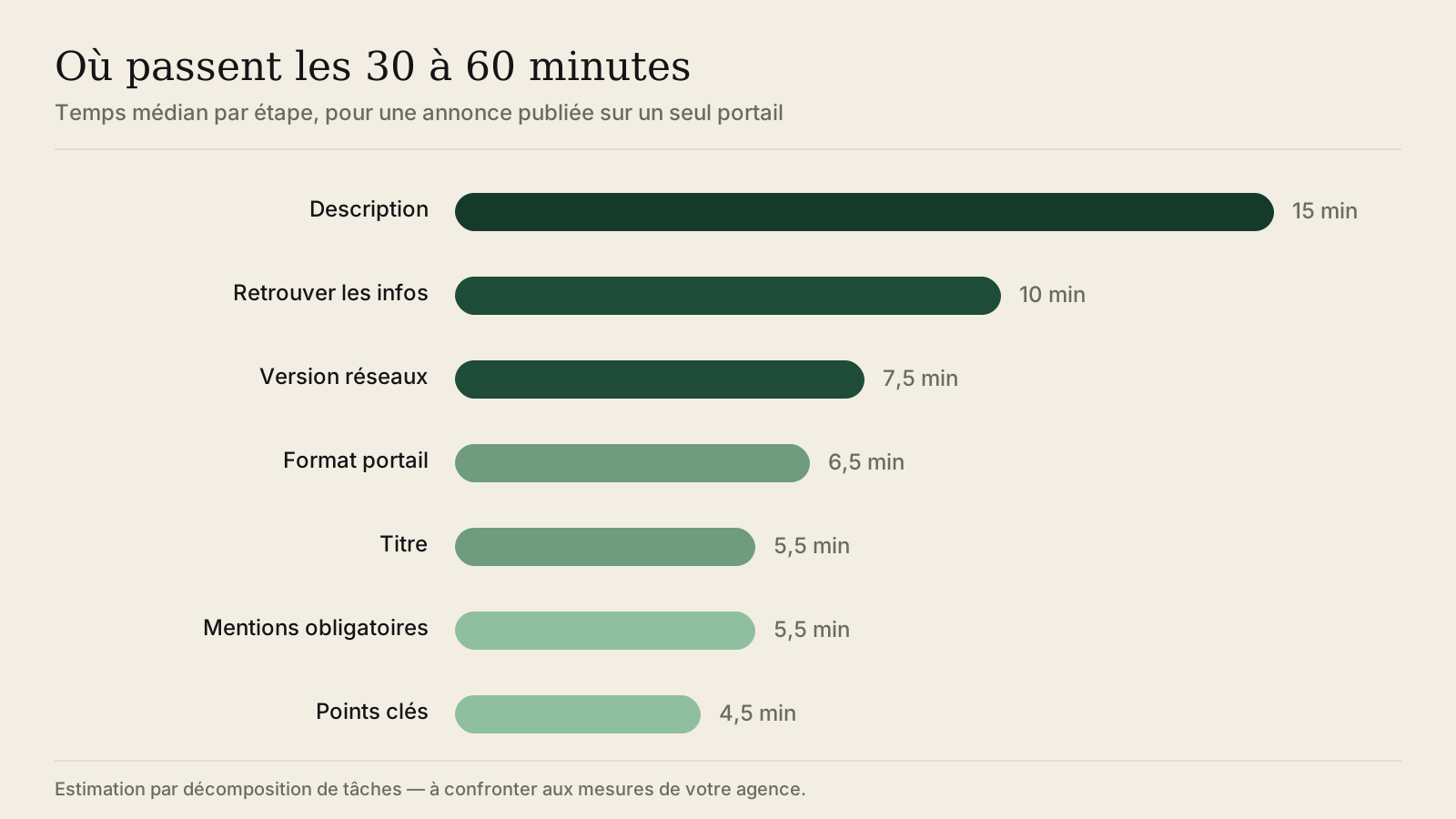 The seven stages of writing a listing, and what each one costs.
| Stage | What it covers | Range |
|---|---|---|
| Finding the information | Size, floor, aspect, BER, year of works, distances | 5–15 min |
| Headline | One line that gives a reason to click | 3–8 min |
| Description | 150–300 structured, readable words | 10–20 min |
| Key features | A scannable list pulled out of the rest | 3–6 min |
| Mandatory disclosures | BER, PSRA licence number (IE); DPE, Carrez, Géorisques (FR) | 3–8 min |
| Social version | Short post, hook, rewrite | 5–10 min |
| Portal formatting | Fields, length limits, expected order | 3–10 min per portal |
| Total, one portal | 32–77 min |
Two things stand out. The description and the information hunt are close to half the total between them. And no single stage is long enough for anyone to think about optimising it on its own — the cost is in the accumulation, which is exactly why it goes unnoticed.
These ranges are estimates built by decomposition, informed by conversations with agencies in Ireland and France. They are not a substitute for measuring your own.
[TO VERIFY: replace with figures recorded in your own agency before publishing]
Why the number varies so much between agencies
The gap between 30 and 75 minutes almost never comes from typing speed. It comes from the state of the information at the moment the agent sits down to write.
An agent holding everything from the viewing writes quickly. An agent who has to reopen the file, ring the vendor to confirm a floor area, or dig out the year the insulation was done takes twice as long — and most of that is not writing, it is archaeology.
Three other factors matter:
- Time of day. A listing written after four viewings takes longer and reads worse.
- Number of channels. Main portal, secondary portal, window card, social: each wants a slightly different shape.
- Property type. A studio letting describes itself in ten lines. A family home with outbuildings needs real prioritising.
How to measure your agency's real number in a week
Don't look for a benchmark — measure. Four steps, no tooling required.
- Pick five representative listings from your book. Not the five easiest: a realistic mix of property types.
- Time it end to end, from the moment the agent opens a blank document to the moment it is live. Don't change habits — you are measuring what exists, not setting a record.
- Log time spent finding information separately. It is the line everyone forgets and the one that shrinks most easily.
- Take the median, not the mean. One awkward listing is enough to distort an average of five.
A week later you have a number that belongs to your agency. Multiply it by your monthly instructions and you have the real cost of listing copy — and a baseline for any tooling decision.
What genuinely reduces the time
Not every idea works. Some are popular and have no measurable effect.
What changes little or nothing:
- Fixed text templates. They speed up the first half of a description and stall the second — the half where you have to say what makes this property worth seeing. The result reads like a form.
- Writing as a pair. Time simply moves from writing to coordinating.
- Leaving it until the evening. Cost per listing climbs as the day goes on.
What genuinely works:
- Capture the information at the viewing, not three hours later. It is the only lever that attacks the heaviest line in the table.
- Separate capture from writing. Describing a property out loud, with no thought for form, takes one to two minutes. Shaping it is a separate problem.
- Produce once for every channel. The social version should derive from the listing, not be rewritten from scratch.
- Move from writing to reviewing. Correcting structured text is markedly faster than facing a blank page — and the output is more consistent between agents.
What changes between Ireland and France
The time is not the same on either side of the Irish Sea, mostly because of mandatory disclosures and the order readers expect.
In Ireland, a listing must display the property's BER rating, and the agent must show their PSRA licence number. Irish readers scan the BER and the area first, and think in bedrooms.
In France, a listing must carry the DPE labels (energy and climate), the estimated annual energy spend, the loi Carrez floor area for apartments in a co-ownership, the agency fees and how they are split, plus the reference to Géorisques. These are checked more than written, but they add an unavoidable verification step. French readers look for the floor area and the room count first.
[TO VERIFY: disclosure requirements change regularly in both countries. Confirm what is in force before publishing.]
Official sources: the SEAI's BER guidance for Ireland, and the French DPE rules for France.
We go into the detail in Daft and SeLoger want different things.
Before and after: one viewing, two listings
Here is what the same viewing produces depending on whether you write cold or from an immediate description. Illustrative example, written for the demonstration — not a real listing.
Raw voice note, recorded walking back to the car:
right so rathmines, two bed, first floor… seventy four square metres I think, BER is C1. south facing garden out the back, quite private, nobody overlooking. rewired last year and they did the insulation at the same time. luas is five minutes walk maybe. second bedroom needs a bit of paint. asking four twenty five.
Publishable listing:
Bright two-bed with a private south-facing garden, Rathmines
A first-floor two-bedroom apartment of 74 m² in the heart of Rathmines, Dublin 6. The south-facing garden to the rear is properly private, with no overlooking neighbours. Rewired and insulated last year, so the practical work is already done. The Luas green line is a five-minute walk. The second bedroom is compact — well suited to a home office or a child's room.
BER C1 · 74 m² · First floor · South-facing garden · Rewired 2025
The content is identical. What changed is the order, the hierarchy, and the honest handling of the weak point — the small bedroom is named, not hidden. That work is what fills the 30 to 60 minutes, and it is what can be moved from writing to reviewing.
On the headline itself, see what a listing headline is actually for.
What if the agent talked instead of typing?
If the table above made you wince, the explanation is simple: the expensive part is not knowing the property, it is shaping the text. The agent knows everything the moment they close the door. Thirty minutes later, some of it is already gone.
That is the idea behind Dictae: the agent records a one- to two-minute voice note straight after the viewing and gets the full listing back — headline, description, key features and a social post — in the shape the portal expects. They read it, fix what matters, publish. Nothing goes out without a human deciding it should.
We are not claiming this takes listing time to zero. The review stays, and it should. The point is to move the effort from writing to checking, where the agent's judgement actually earns its keep.
In short
Writing a property listing takes 30 to 60 minutes, and most of that is spent before the first sentence — reconstructing information the agent knew perfectly well walking out of the viewing. Measure your own number across five listings this week. It is the only figure that lets you decide anything.
For the full framework, see the complete guide to writing property listings. And if you want to see what the process does with one of your own listings, book a 10-minute call.